
See every award strategy play out before you choose one
Lowest cost, better service, or more diversified capacity? Every award decision comes with trade-offs. AI Scenario Builder turns your award goals into optimization scenarios you can compare side by side. Just describe them to Laney in plain English.
Request a demo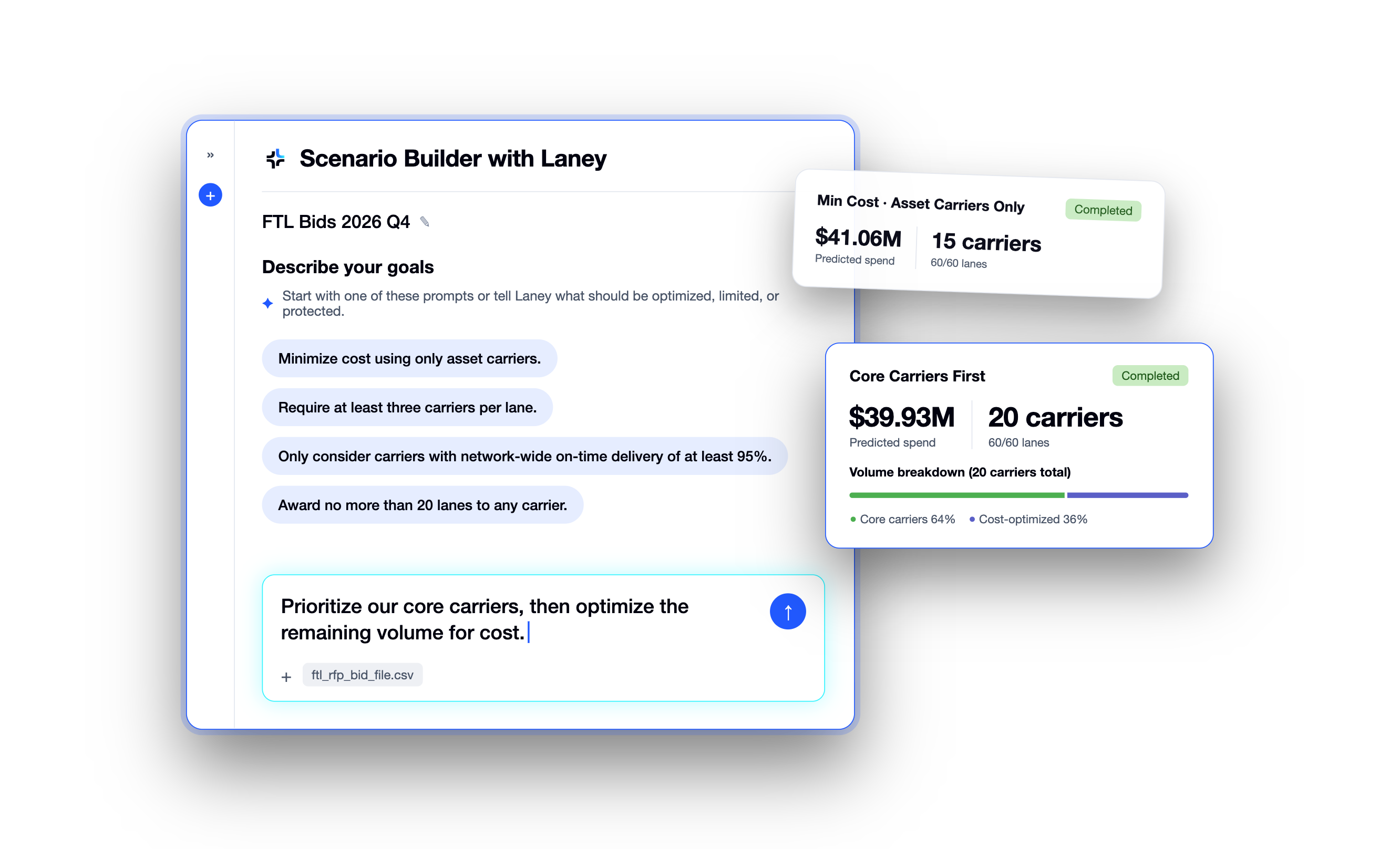
Collecting bids is only half the job
The harder part is deciding how to award freight under your business rules. Testing one more strategy can mean hours of spreadsheet modeling and dedicated analyst time. And when capacity, carrier performance, or priorities shift, the work starts over.
Explore more options in less time
Model complex award rules in plain English
Tell Laney what matters, from on-time performance thresholds to lane limits per carrier. She turns your goals into optimization scenarios with no complex forms to configure.
Compare the trade-offs side by side in seconds
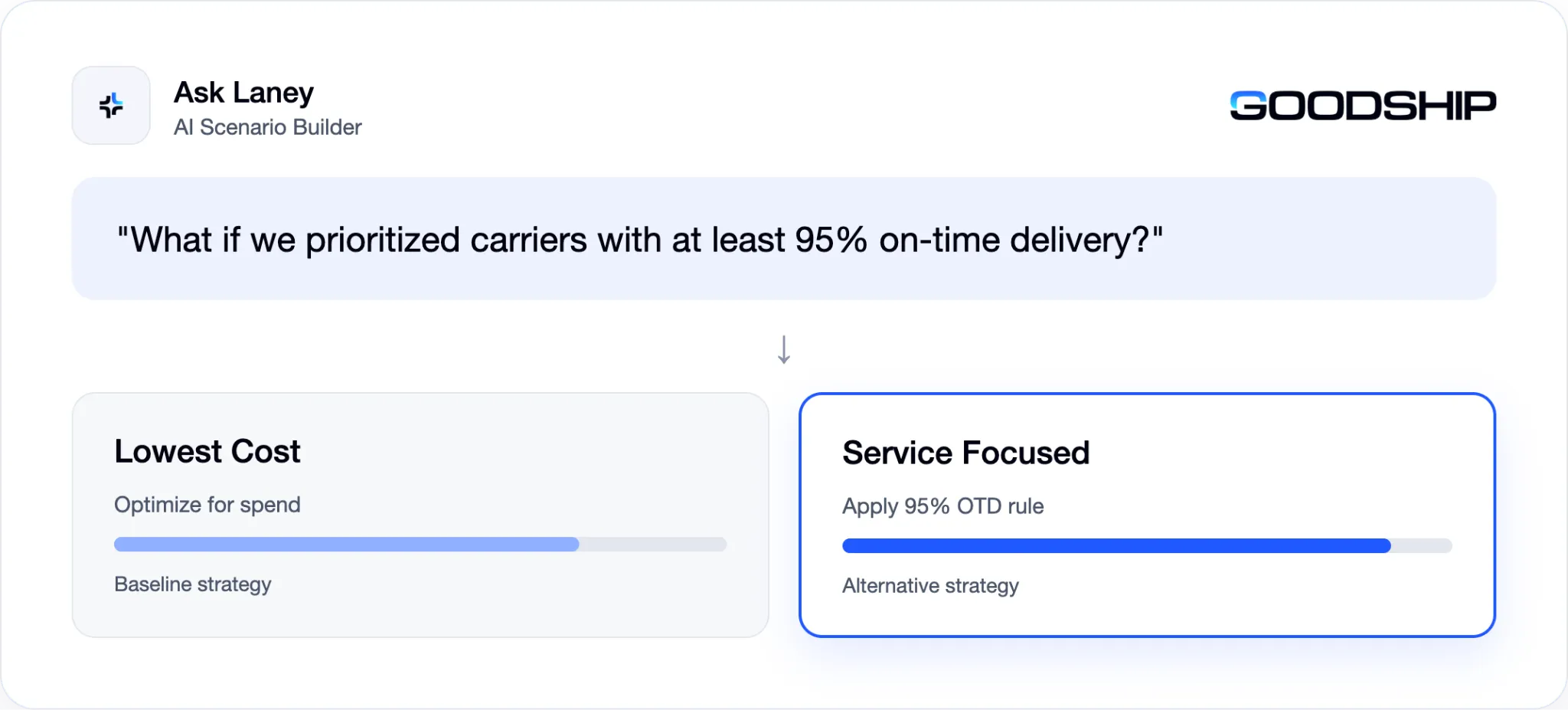
See how each strategy changes spend, carrier mix, incumbency, and average carriers per lane. Every scenario is measured against a low-cost baseline, so you know exactly what each rule costs.
Keep every bid cycle in one place
Bid files, carrier notes, conversations, and scenario history live together in one project workspace. Export results to Excel or CSV when it's time to share.
Ask the what-ifs that matter to your network

Scenario Builder with Laney
Business question
Ask Laney
Raise service standards
“Only consider carriers with at least 95% on-time delivery.”
Diversify capacity
“Require at least three carriers per lane.”
Limit carrier concentration
“Award no more than 20 lanes to any carrier.”
Protect preferred relationships
“Prioritize our core carriers, then optimize the remaining volume for cost.”
Focus on asset capacity
“Minimize cost using only asset carriers.”
Describe your goals, GoodShip builds the scenarios
Start a project with your bid data
Upload your bid file along with rate sheets, carrier notes, or other supporting documents. Everything stays in one workspace for the full bid cycle.
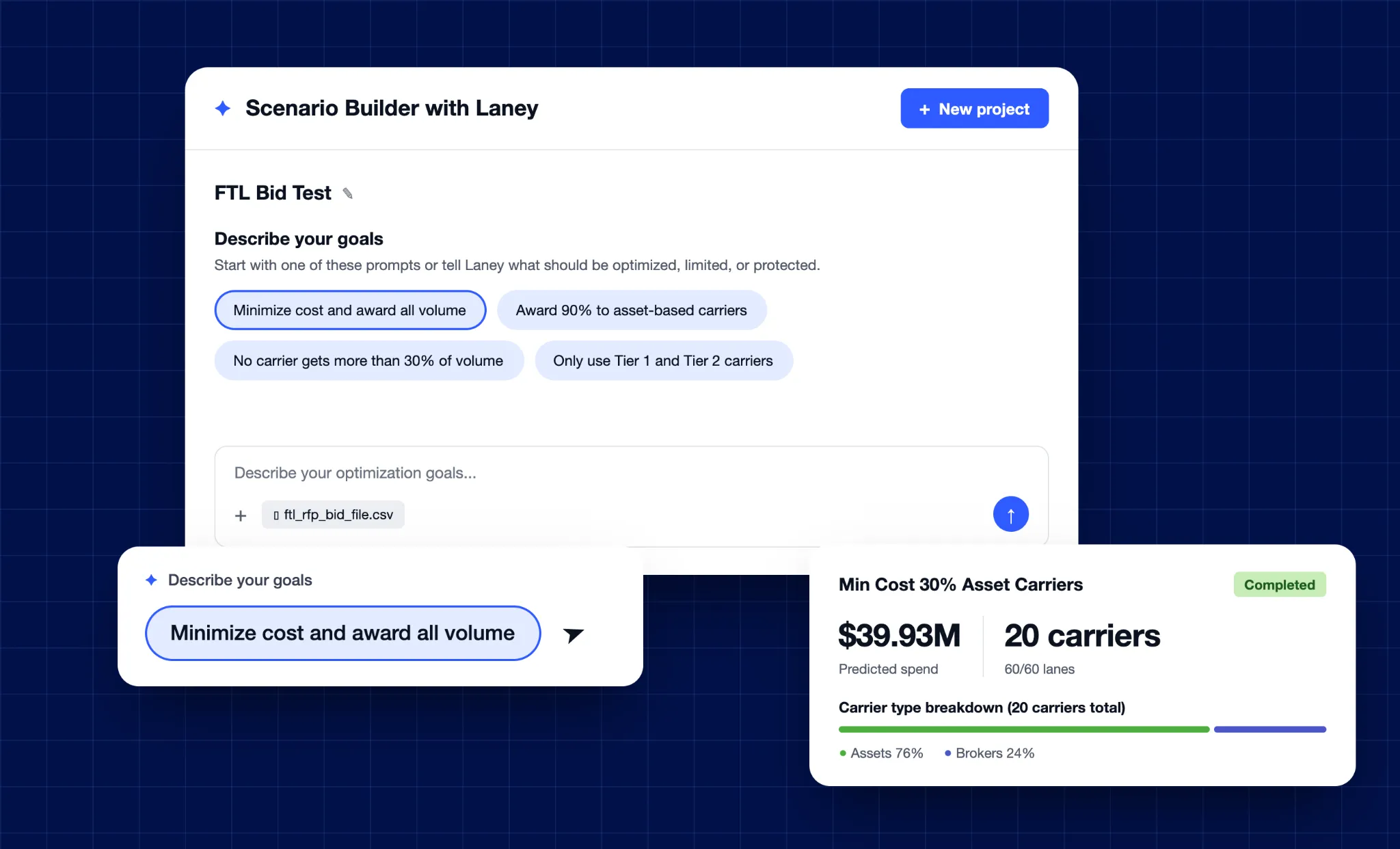
Tell Laney how you want to award
Ask her to minimize cost, prioritize specific carriers, or enforce rules like a minimum number of carriers per lane. If a rule can't be met, Scenario Builder flags it so you can adjust.
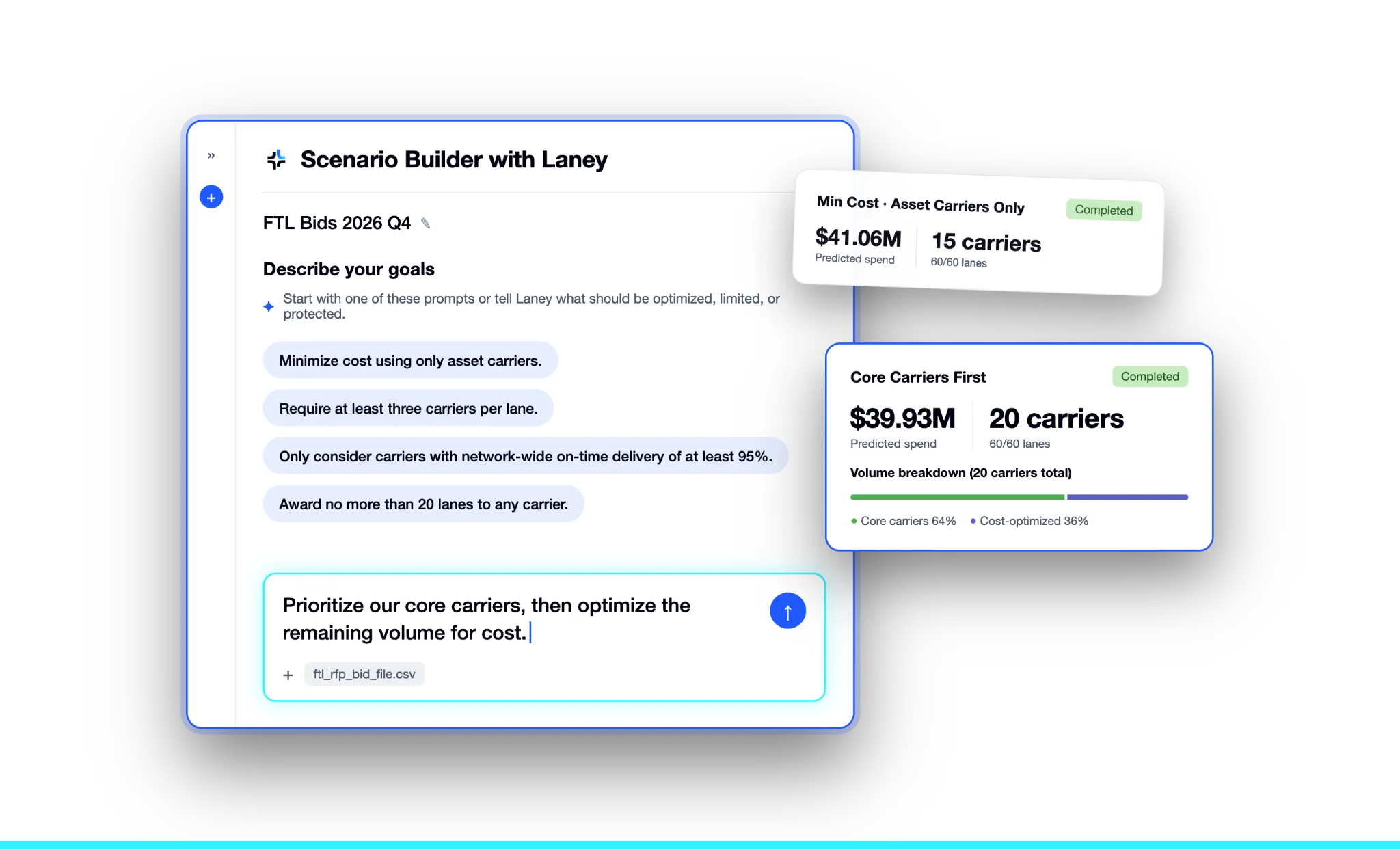
Compare, refine, and decide
Duplicate a scenario to test a variation and review results side by side. Ask follow-ups like which carrier received the most volume, and get the answer without digging through the output.
Go from what-if to what works.
Test more award strategies, see the trade-offs clearly, and spend less time building the analysis behind every decision.
Request a demoYou've got questions, we've got answers
What is AI Scenario Builder?
AI Scenario Builder helps shippers build and compare freight award strategies by describing their goals in plain English. Powered by Laney, it turns bid data and business rules into optimization scenarios, without complex forms or manual spreadsheet modeling.
What business rules can I model?
You can ask Laney to minimize cost, prioritize specific carriers, or enforce rules such as a minimum number of carriers per lane. Supported rules include carrier eligibility (for example, asset-based carriers only), on-time performance thresholds, remaining-volume conditions such as prioritizing core carriers and optimizing the rest for cost, and limits on the number of lanes awarded to each carrier.
What do I need to get started?
Create a project with a bid file and any supporting documents, such as rate sheets or carrier notes. Then describe your goals to Laney, or start from one of the suggested prompts.
How is this different from the original Scenario Builder?
AI Scenario Builder supports more advanced constraints, including on-time performance filters, remaining-volume conditions, and lane-count limits per carrier. It also adds a standalone project workspace that keeps files, conversations, and scenarios together across a bid cycle.
Can I compare and export scenarios?
Yes. You can build multiple scenarios, duplicate them to test variations, and compare results side by side. Results can be exported to Excel or CSV for further analysis and sharing.
Is a project tied to a single RFP?
No. A project keeps bid files, carrier notes, conversations, and scenario history together without being tied to a single RFP event, so your team can keep working in it as new questions come up.


