
GoodShip unifies your transportation data, pinpoints the opportunities and risks that matter most, and helps your team act on them.
Request a demoSee the What-Ifs Play Out: Simplifying Freight Award Scenario Analysis

Freight procurement comes with no shortage of what-if questions. GoodShip's AI Scenario Builder lets shippers build, compare, and refine freight award scenarios by describing their goals to Laney in plain English, without complex forms or manual spreadsheet modeling.
Freight procurement comes with no shortage of what-if questions. What if you prioritized service over cost? Awarded more freight to preferred carriers? Or limited how many lanes a single carrier could receive?
For many shippers, answering those questions isn't simple. Modeling different award strategies often requires hours of spreadsheet work, complex business rules, and dedicated resources to analyze the results. And when market conditions, carrier performance, or business priorities change, teams may need to repeat that process.
The challenge isn't coming up with different scenarios. It's having the time and resources to model, compare, and understand them.
GoodShip's AI Scenario Builder makes that analysis easier. Shippers can build, compare, and refine freight award scenarios simply by describing their goals in plain English, without complex forms or manual spreadsheet modeling.
See the what-ifs play out with AI Scenario Builder
A shift in capacity, a change in carrier performance, or a new business requirement can introduce an entirely different set of considerations into an existing award strategy.
With AI Scenario Builder, teams can quickly explore those variables by asking Laney to create optimization scenarios, adjusting constraints, and comparing how different approaches affect their network.
For example:
- Prioritize cost: "Minimize total transportation spend using eligible carriers."
- Raise service standards: "Only consider carriers with at least 95% on-time delivery."
- Diversify capacity: "Require at least three carriers per lane."
- Limit carrier concentration: "Award no more than 20 lanes to any carrier."
- Protect preferred relationships: "Prioritize our preferred carriers, then optimize the remaining volume for cost."
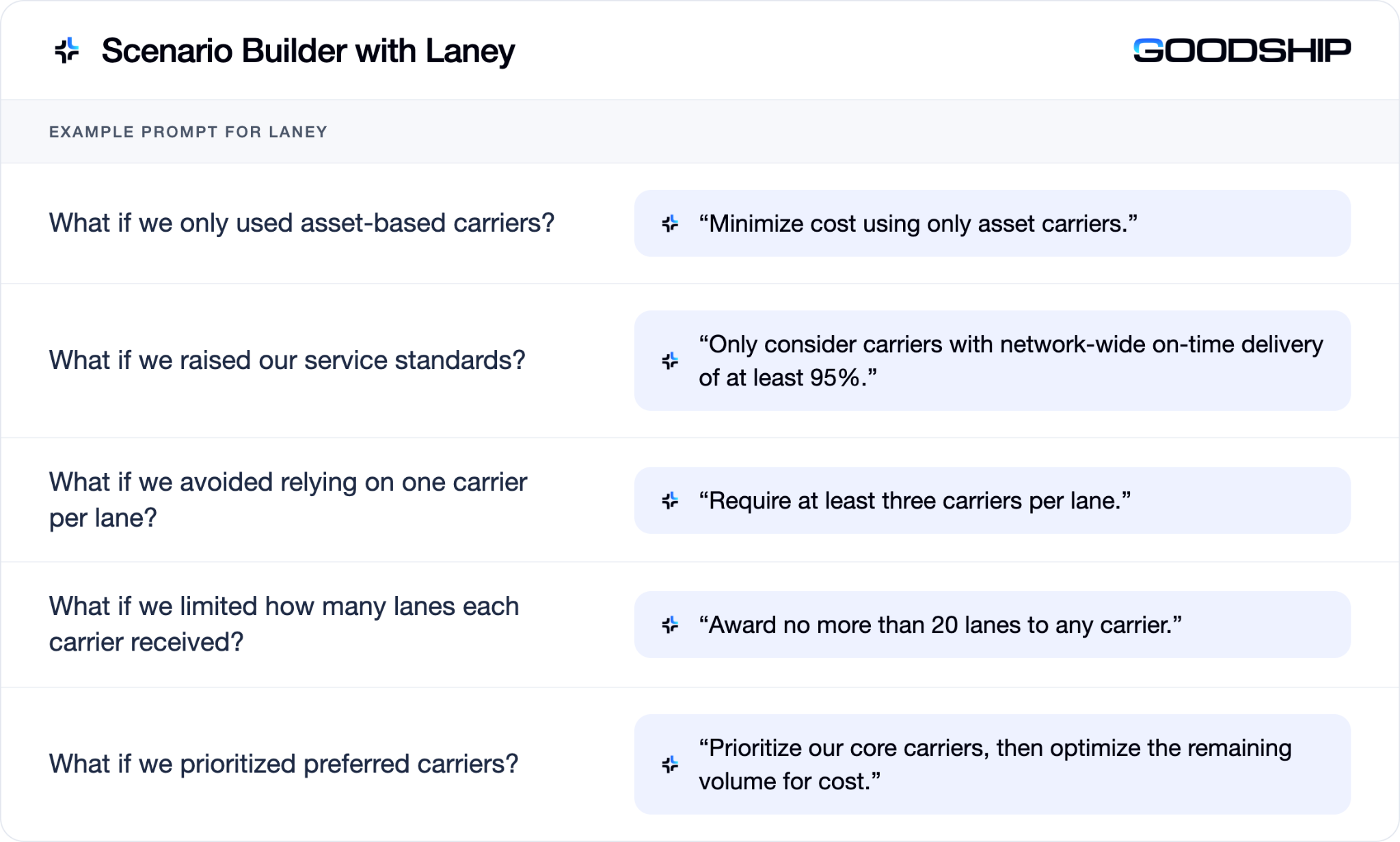
Teams can test different approaches using the same bid data, adjust business rules, and compare how those changes affect cost and carrier allocation.
Less modeling. More time for analysis.
AI Scenario Builder simplifies three key parts of freight award scenario planning.
Build scenarios using plain English. Describe your procurement goals to Laney, and she translates them into optimization scenarios. Teams can apply business rules such as carrier eligibility, on-time performance thresholds, remaining-volume conditions, and lane-count limits without navigating complex forms or manually modeling constraints.
Compare scenarios without starting over. Testing a different strategy shouldn't mean rebuilding your analysis from scratch. Duplicate existing scenarios, adjust constraints, and compare results side by side to see how different priorities affect cost and carrier allocation. Whether you're testing stricter service requirements or limiting carrier concentration, teams can explore more possibilities without the repetitive spreadsheet work.
Keep your data and analysis connected. Bid files, carrier notes, supporting documents, conversations, and scenario history stay together in a dedicated project workspace. Once scenarios are generated, teams can ask Laney follow-up questions about the results, such as which carriers received the most volume, rather than manually investigating each output. Results can also be exported to Excel or CSV for further analysis and sharing.
From what-if to what works
Freight networks are constantly changing, and transportation teams need the flexibility to evaluate different approaches as new questions arise.
But meaningful scenario analysis shouldn't depend on hours of manual modeling or dedicated spreadsheet expertise.
With GoodShip's AI Scenario Builder, shippers can explore more possibilities, compare the trade-offs, and spend less time building the analysis needed to make informed decisions.
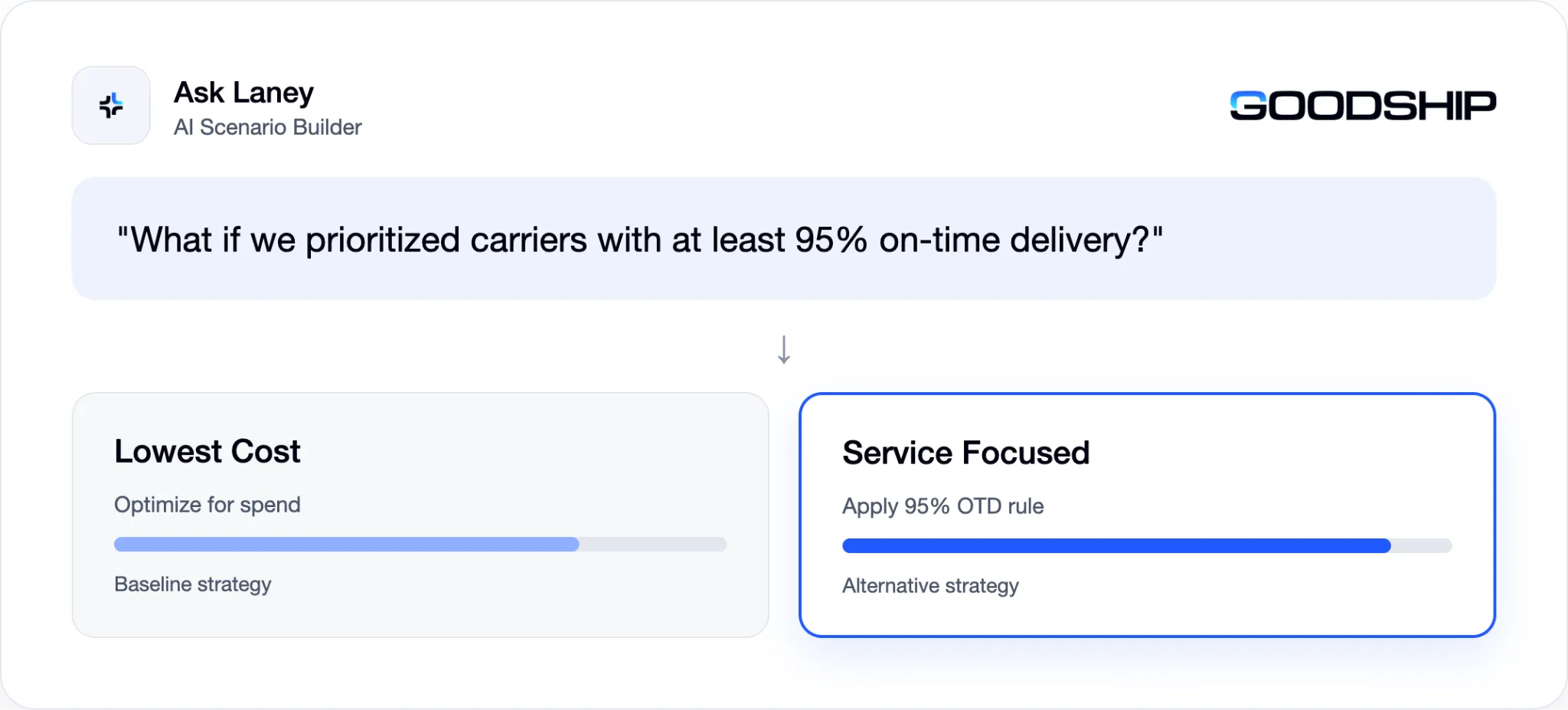
Explore every angle. Skip the manual modeling.
Frequently asked questions
Fill out the form and our team will reach out to schedule a walkthrough of GoodShip.


