
What Causes Freight Software Visibility Blind Spots
Director of Growth Marketing at GoodShip
Your freight data lives in multiple places: your loads in one system, contracts in another, market benchmarks somewhere else entirely. When these data sources don't connect, you lose the ability to see what's happening across your network at the lane level. This gap is what creates freight software visibility blind spots: the hidden zones where cost signals and service trends go unnoticed until they become expensive problems.
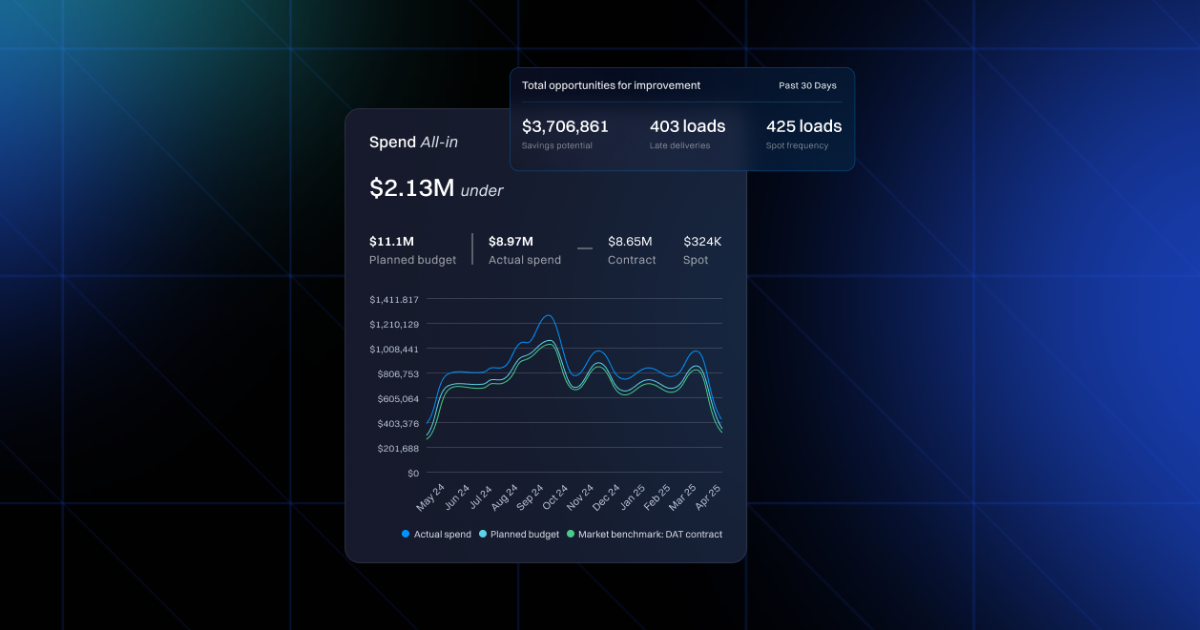
GoodShip unifies your transportation data from loads, tenders, contracts, and market rates into one platform, giving you the lane-level clarity needed to act on what you know. In this article, you'll learn what causes these visibility gaps, why they matter for your freight program, and how to close them.
Key Takeaways: What Causes Freight Software Visibility Blind Spots
- Disconnected loads, tenders, contracts, and market benchmarks create data quality issues that hide lane-level cost signals.
- Most mid-market shippers cannot produce lane-level freight data in under 24 hours due to system fragmentation.
- GoodShip brings together spend, performance, and rate data in one view to eliminate gaps and speed up decision-making.
- Visibility blind spots lead to missed savings, weaker accountability, and slower procurement cycles.
- Unifying your freight data into a single source of truth is the first step to regaining control of your network.
What Are Freight Software Visibility Blind Spots?
Freight software visibility blind spots are the gaps in your network where you cannot see cost, service, or performance data at a meaningful level of detail. These gaps form when your systems store information separately and don't share context across functions.
For example, your loads might live in one tracking tool while your contract rates sit in a procurement portal. Without a connection between them, you can't answer questions like: "Are we actually paying what we agreed to on this lane?" or "Which routes are underperforming compared to last quarter?"
According to a 2026 Inbound Logistics report, many organizations still operate in silos despite significant investments in digital tools. The result is insight into individual nodes, but not the full picture.
Why Do Disconnected Data Sources Create Visibility Gaps?
Visibility gaps emerge when your freight management software pulls from separate, unconnected sources. Your tender data might come from your load board, contract data from procurement, and market benchmarks from an external feed. Each source has its own structure, timing, and level of detail.
When these sources don't sync, your data becomes stale or inconsistent. A 2026 study by Trax Technologies found that data fragmentation across carriers, regions, and systems is one of the most costly and underestimated problems in enterprise supply chain operations.
This fragmentation means your finance team sees one version of transportation spend while procurement sees another. Operations works from planning data rather than actuals. When these teams try to reconcile their views, the effort consumes time that should go toward analysis and action.
How Do Visibility Blind Spots Affect Your Freight Procurement?
When you run procurement events without lane-level visibility, you're making decisions based on incomplete information. You might accept bids that look competitive on paper but miss that a specific lane has consistently underperformed. Or you might award volume to providers without seeing how they've trended against your contracted rates.
A Freightos survey found that 73% of procurement teams still rely on spreadsheets and disconnected systems. This manual approach introduces cost variability and slows down bid cycles.
GoodShip's transportation analytics platform connects your historical performance data directly to your procurement tools. This means you can run RFPs and mini-bids with embedded market benchmarks and carrier scorecards—all in one place.
What Role Does Market Benchmarking Play in Closing Visibility Gaps?
Market benchmarks give you an external reference point to evaluate your rates. Without them, you're comparing your costs only against your own history—which might already be inflated. You need to know whether the rate you're paying on a lane is competitive with what the market is actually charging.
GoodShip embeds market rate data from DAT, Truckstop, and FreightWaves SONAR directly into your network view. This allows you to compare your contracted rates against current market conditions at the lane level, spotting opportunities to renegotiate or shift volume.
When you combine internal spend data with external benchmarks, you can identify lanes where you're overpaying and prioritize them for action. This approach helps you move from reacting to rate increases to proactively managing your cost-to-serve.
How Can You Measure the Impact of Visibility Blind Spots?
The impact of visibility blind spots shows up in several measurable ways. First, look at how long it takes your team to answer basic questions about your freight spend. If producing a lane-level cost report requires pulling data from multiple systems and takes more than a day, that's a visibility problem.
Second, examine your invoice error rate. Industry data suggests that up to 15% of freight invoices contain errors, and many of those go unnoticed when you lack the visibility to catch discrepancies automatically.
Third, consider your accountability metrics. Can you track on-time delivery and tender acceptance at the lane level? If not, you're missing performance signals that should inform your procurement and routing decisions.
What Steps Can You Take to Close Freight Visibility Gaps?
Start by auditing where your freight data currently lives. Map out your loads, tenders, contracts, and rate sources. Identify which systems feed into your analytics and where data handoffs break down.
Next, prioritize unification. Look for a freight orchestration platform that can ingest data from your existing systems without requiring a full technology overhaul. GoodShip connects to your current setup and enriches your data with real-time market rates—typically going live in four weeks with no technical resources required.
Finally, build visibility into your workflow. Your team should be able to see cost and service signals in the same place they take action, whether that's running a bid, reviewing a scorecard, or flagging a rate variance.
In Conclusion: Taking Control of Your Freight Network Visibility
Freight software visibility blind spots form when your data sources (loads, tenders, contracts, and market benchmarks) don't connect. These gaps hide cost signals, slow down procurement, and weaken your ability to hold providers accountable.
Closing these gaps requires unifying your data into a single view that supports lane-level analysis and action. GoodShip helps you do exactly that, bringing together your transportation data and embedding market intelligence so you can make faster, more confident decisions across your freight network.


