
Transportation procurement software that helps you make better decisions
Director of Growth Marketing at GoodShip
Transportation procurement software has matured over the past decade.Most teams today already have tools to run RFPs, collect bids, and manage routing guides. The process itself is structured and repeatable.Where things still get difficult is after the bids come in.
Teams are left trying to answer practical questions:
- Are these rates actually competitive?
- Did we structure the awards correctly?
- Where are we still leaving money on the table?
The challenge is not running procurement events. The challenge is making confident decisions based on the results.

What Transportation Procurement Software Is Designed to Do
At a basic level, transportation procurement software supports:
- Running sourcing events
- Collecting and comparing carrier bids
- Awarding lanes
- Maintaining routing guides
These are necessary capabilities. They make procurement more efficient and easier to manage.
But procurement decisions are rarely straightforward.
Every award involves tradeoffs:
- Lower cost versus higher service reliability
- Existing carriers versus new entrants
- Coverage across the network versus concentration risk
Most tools present the data, but they do not always make those tradeoffs easier to evaluate.
Why Procurement Decisions Still Slow Teams Down
Even with clean bid data, teams often rely on manual workflows to reach conclusions.
A typical process looks like this:
- Export bid data
- Build custom models in spreadsheets
- Review scenarios across multiple stakeholders
- Reconcile assumptions before making a decision
This approach works, but it takes time. It also introduces inconsistencies, especially when different teams interpret the data in different ways.
As a result, procurement cycles become slower, and decisions are often made with partial visibility.
Where Better Decisions Come From
Strong procurement outcomes depend on context, not just bids.
Teams need to understand:
- How carriers have actually performed
- Where costs tend to increase during execution
- Which lanes behave differently over time
Without that context, decisions are based on static inputs.
With that context, procurement becomes more grounded. Teams can see not just what carriers are offering, but how those offers translate into real-world performance.
What Modern Transportation Procurement Software Looks Like
Procurement tools are starting to move in a different direction. The focus is shifting from managing events to improving decisions within those events.
A modern system should help teams:
Evaluate scenarios without rebuilding analysis each time
Teams should be able to compare award strategies quickly, without exporting data or starting from scratch.
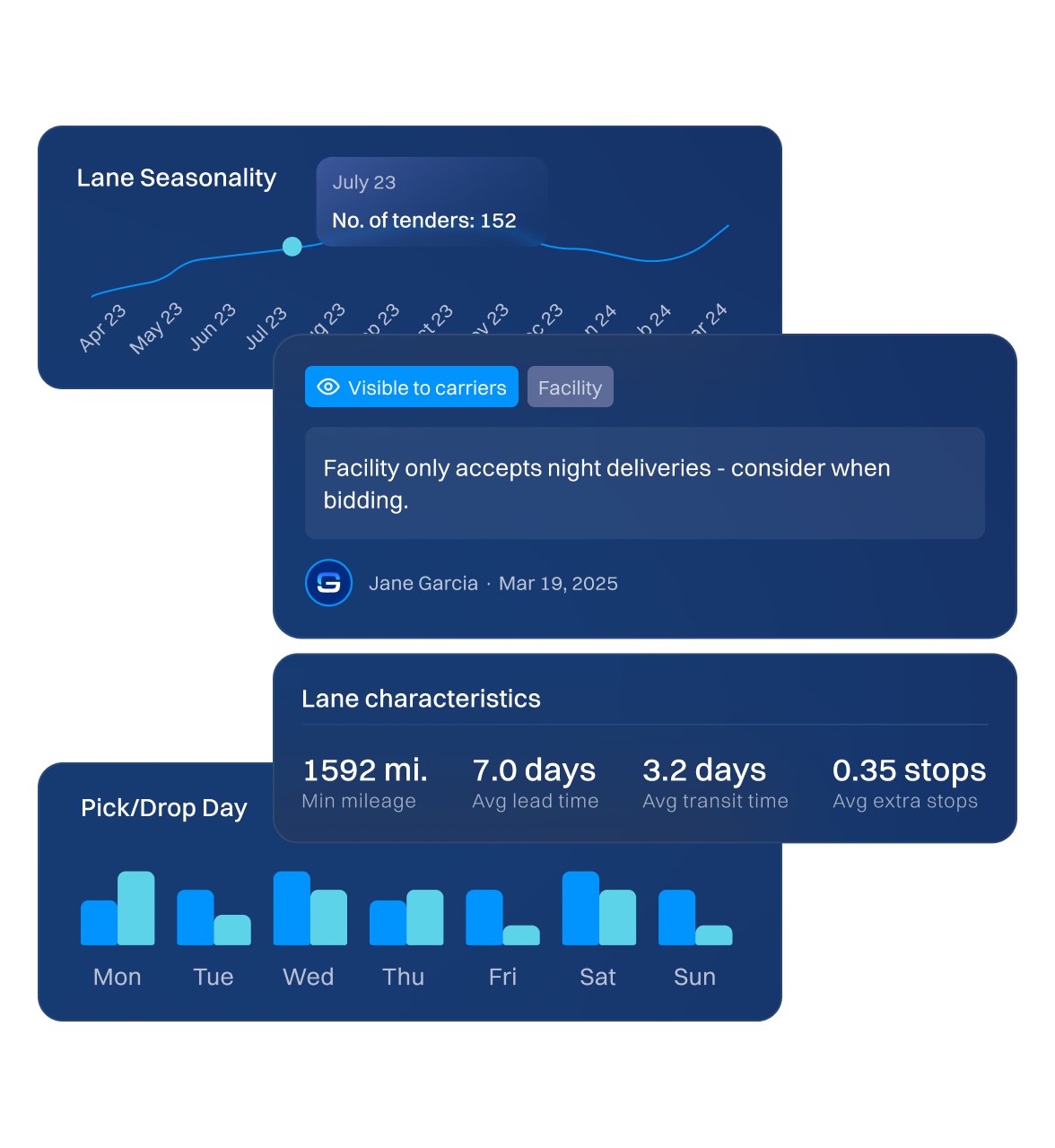
Bring performance data into procurement decisions
Carrier reliability, historical cost patterns, and service levels should be visible alongside bid data.
Highlight where savings actually exist
Savings are not always tied to the lowest rate. They often come from better alignment between carriers, lanes, and execution patterns.
Reduce dependence on spreadsheets
Teams should not need to rebuild the same analysis every procurement cycle. The system should support repeatable, consistent decision-making.
How GoodShip Supports Transportation Procurement
GoodShip focuses on improving how procurement decisions are made, not just how procurement events are run.
With GoodShip Procurement, transportation teams can work directly with their network data instead of relying on static exports and manual analysis.
At the center of this approach is Laney, GoodShip’s AI transportation analyst.
Laney allows teams to:
- Ask procurement questions in plain language
- Analyze lanes, carriers, and bids instantly
- Explore different award scenarios and see the impact immediately
Because Laney is connected to transportation data across loads, carriers, and procurement events, the analysis reflects how the network actually operates.
From Static Comparisons to Ongoing Decision Support
This changes how procurement feels in practice.
Instead of working through spreadsheets and one-off models, teams can interact with their data more directly. Questions that used to require hours of analysis can be answered in seconds.
This does not replace the procurement process. It makes the process more responsive and easier to navigate.
Teams can:
- Validate assumptions more quickly
- Focus attention on the lanes that matter most
- Adjust decisions with a clearer understanding of tradeoffs
What This Means for Transportation Teams
When procurement software supports decisions, not just process, teams start to see practical improvements:
- Shorter procurement cycles
- More consistent evaluation of bids
- Better alignment between procurement and execution
- Less time spent on manual analysis
Over time, this leads to more stable networks and fewer surprises after awards are implemented.
The Bottom Line
Transportation procurement software has already solved the problem of running sourcing events efficiently.
The next step is improving how decisions are made within those events.
That requires:
- Better visibility into network performance
- Faster access to answers
- Tools that support evaluation, not just data collection
When teams have that, procurement becomes more than a periodic exercise. It becomes a more reliable way to improve cost, service, and overall network performance.


