
Freight Optimization Software: What It Actually Means (and Why Most Tools Miss the Mark)
Director of Growth Marketing at GoodShip
If you ask a transportation team how they optimize freight, the conversation usually starts with rates. Carrier bids. Routing guides. Procurement cycles. And those things matter. But they’re not where most of the cost lives. The reality is simple: freight doesn’t break during planning, it breaks during execution. Shipments don’t follow routing guides perfectly. Carriers deviate. Delays happen. Accessorials show up. And by the time anyone looks closely, the shipment is already complete and the cost is already incurred. That’s why a lot of “freight optimization software” ends up underdelivering. It helps you make better plans—but it doesn’t help you manage what actually happens.
What Freight Optimization Software Is Supposed to Do
At a high level, freight optimization software is meant to help transportation teams:
- Reduce cost per shipment
- Improve carrier selection and performance
- Increase network efficiency
- Identify and eliminate waste
Traditionally, this has been approached through network design tools, routing optimization, and procurement platforms.
These systems are good at answering questions like:
- What’s the best carrier for this lane?
- How should we route this shipment?
But they struggle with a much more important question: what’s happening right now and what should we do about it?
The Gap Between Planning and Execution
Most transportation teams don’t lack data. They lack usable visibility.
Information is spread across TMS platforms, carrier portals, broker updates, and internal systems.
Each system tells part of the story, but none of them tell the full story in real time. So what happens?
Teams fall into reactive workflows:
- Investigating issues after delivery
- Auditing costs after invoicing
- Explaining problems instead of preventing them
And that’s where optimization breaks down. Because once a shipment is complete, you can analyze it, but you can’t fix it.
Where Freight Costs Actually Come From
There’s a persistent belief that cost savings come primarily from procurement.
Better bids. Better rates. Better contracts. But in practice:
Most overspend happens after the RFP during execution.
Common sources of hidden cost include:
- Accessorial charges that weren’t visible early
- Carrier performance issues that weren’t flagged
- Delays that cascade across shipments
- Manual processes that slow down response time
None of these are solved by better planning alone.
They require continuous visibility and intervention during execution.
What Modern Freight Optimization Looks Like
Freight optimization is evolving from a planning problem into an execution problem. Modern approaches focus less on predicting the perfect plan and more on managing reality as it unfolds.
This is where AI starts to play a meaningful role, not as a replacement for systems, but as a layer that makes them usable. A modern freight optimization platform should be able to:
1. Connect fragmented transportation data
Instead of logging into multiple systems, teams should have a unified view of:
- Shipments
- Costs
- Carrier performance
This isn’t just about dashboards, it’s about having a single source of truth that reflects what’s happening now.
2. Surface issues automatically
Teams shouldn’t have to go looking for problems.
The system should proactively identify:
- Cost anomalies
- Service deviations
- Performance outliers
And do it early enough that action is still possible.
3. Provide answers, not just data
Most tools give you data. Fewer tools tell you what it means.
For example:
- Not just “cost increased”
- But “cost increased due to recurring detention on this lane”
This is where AI reduces the time between question → insight → action.
4. Enable action during execution
This is the most important shift.
Freight optimization shouldn’t end once a shipment is planned.
It should continue while shipments are in transit, at risk, or deviating from expectations.
Because that’s the only moment when optimization actually changes outcomes.
Why Generic AI Tools Aren’t Enough
Some teams try to solve this with general-purpose AI tools—building workflows with ChatGPT, dashboards, or internal data pipelines.
These can be helpful, but they usually run into the same problems:
- Data isn’t fully integrated
- Context is inconsistent
- Insights aren’t tied to operational workflows
In other words, the output might be smart but it’s not operationally useful.
Freight optimization requires AI that is:
- Embedded in transportation data
- Connected to live workflows
- Designed for how teams actually operate
How GoodShip Approaches Freight Optimization
GoodShip takes a different approach to freight optimization: one that starts with execution, not planning.
Instead of focusing only on what should happen, it focuses on what is happening and what needs attention.
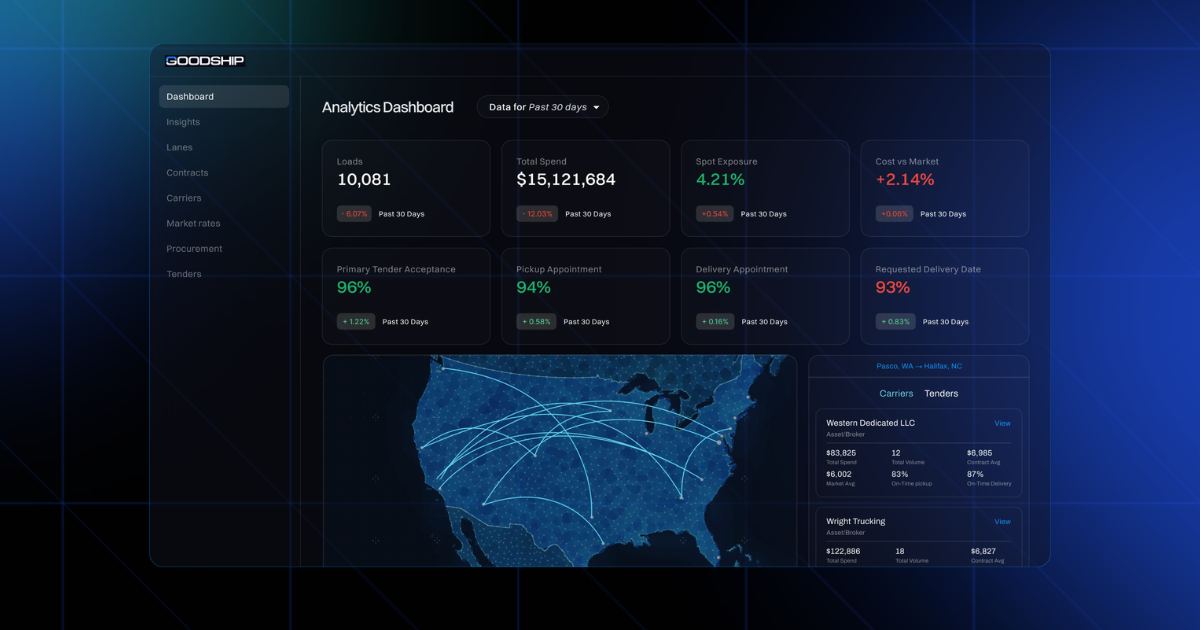
With GoodShip's dashboards and Laney AI Analyst, transportation teams can:
- Ask questions in plain language, like “Why are costs increasing on this lane?”
- Automatically detect anomalies across shipments and carriers
- Monitor execution in real time, without stitching together multiple systems
This shifts the role of the transportation team from reactive analysis to proactive decision-making. Instead of spending time gathering data, teams can focus on resolving issues faster, preventing repeat problems, improving performance continuously.
Freight Optimization Is Really About Visibility
It’s easy to think of optimization as a math problem.
Better algorithms. Better routing. Better predictions.
But in practice, optimization comes down to something much simpler:
You can’t optimize what you can’t see clearly.
Once teams have real visibility into execution:
- Costs become explainable
- Issues become predictable
- Decisions become faster
And optimization stops being a periodic exercise and becomes part of daily operations.
Learn more about how GoodShip can help optimize your freight operations:


